Fibromyalgia: “How Do You Explain Bone Pain?”
Emily Carter describes her pain with a chilling phrase: “H21.”
Twenty-one hours of pain every single day.
“The other three hours were when I slept,” she says. “And even then, I only slept because I was exhausted.”
Emily, a 55-year-old psychiatric nurse, lives with fibromyalgia — a syndrome marked by chronic body-wide pain, extreme fatigue, and unrefreshing sleep. According to U.S. estimates, about 2% of the adult population have Fibromyalgia in the United States. Women represent a large majority of cases—studies report 80% to 90% or more of patients being female.
For Emily, the pain is unlike anything she ever imagined.
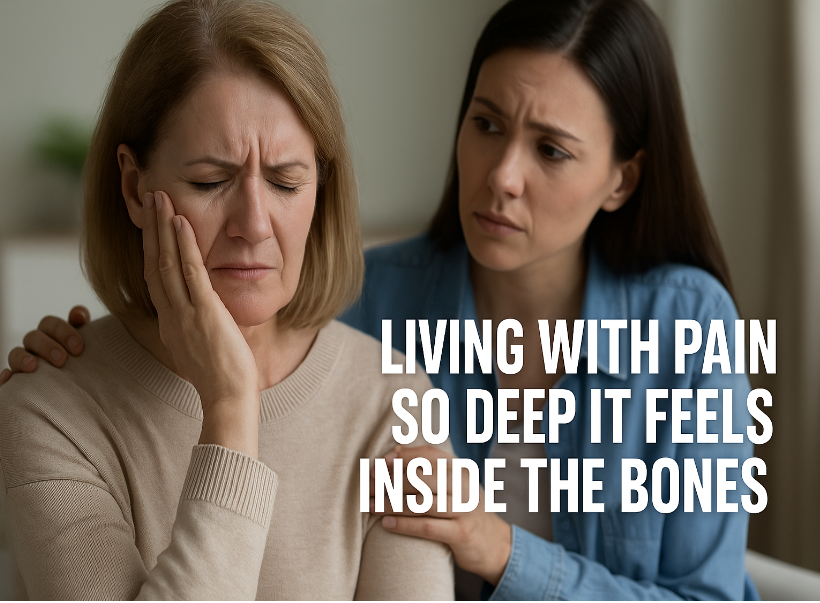
“It feels like it hurts inside the bones… like electric shocks running through me.”
From Ignoring the Pain to Living in a Nightmare
Her first symptoms appeared in the late 1990s, but she brushed them aside. By 2007, the pain had grown impossible to ignore. And by the spring of 2012, her life had collapsed.
“I lived through eighteen months of descent into hell,” she recalls.
“Everything hurt — from the roots of my hair to the tips of my toes. You couldn’t touch me. I couldn’t walk. I woke up more tired than when I went to bed. Painkillers did nothing.”
She now lives with a constant pain level of 6 or 7 out of 10.
Every minute. Every hour. Every day.
“The only thing you think about is pain. The only thing you talk about is pain.”
The Invisible Pain That Steals Your Life
Social life disappears quickly with fibromyalgia.
Not because patients want to withdraw, but because nearly everything triggers pain.
People understand a migraine or a toothache.
But try explaining constant, diffuse, breath-stealing pain — and most simply can’t imagine it.
Carole Robert, president of the Fibromyalgia France association, knows this firsthand.
For thirteen years, doctors thought she had multiple sclerosis.
She received sympathy, empathy… even compassion.
But once diagnosed with fibromyalgia, everything changed.
People questioned her.
“Are you sure you’re sick?”
The disbelief is not only social — it is also medical.
When Doctors Don’t Believe You
Many doctors still dismiss fibromyalgia as psychological.
“We’re trained to look for a cause and a clear treatment,” explains rheumatologist Jean-Luc Renevier.
“But with fibromyalgia, we have neither. That leaves doctors helpless.”
Fibromyalgia remains a medical mystery.
There are many theories, but none conclusively proven.
There is no inflammation, no visible damage, no abnormal scans — yet the pain is real and relentless.
What we do know is this:
the brain of a fibro patient does not filter pain correctly.
Since 1992, the World Health Organization has recognized fibromyalgia as a real condition, yet skepticism persists.
When Misdiagnosis Becomes Dangerous
The lack of understanding has devastating consequences.
Doctors often prescribe:
- high-dose painkillers,
- antidepressants,
- and treatments that don’t target the real problem.
“They give us medication, but they don’t listen,” Blandine says.
Years of medication damaged her liver.
And she’s not alone.
Carole Robert once went to the ER for severe heart symptoms.
Instead of being treated, a nurse insisted it was “in her head” and sent her to a psychiatric emergency unit.
The “imaginary” heart issue?
It was actually atrial fibrillation.
A few months later, she suffered a stroke.
This is what happens when a disease is invisible.
Searching for Relief Beyond Medication
Fibromyalgia cannot be cured, and only a small percentage of patients respond well to painkillers.
So more and more people are turning toward non-medical therapies:
relaxation
qigong
balneotherapy
acupuncture
These approaches don’t erase the pain — they help patients feel less overwhelmed by it.
“We think less about the pain. We free the mind,” says Carole.
Blandine agrees.
“I still feel pain, but I’m not suffering anymore,” she says. “I no longer have dark thoughts.”
She has accepted her condition and now trains in qigong herself, planning to create an association for people living with chronic pain.
And the best part?
Her medical expenses have dropped dramatically — from €300–400 a month to just €38 for acupuncture sessions.
Fibromyalgia: A Life of Pain, Misunderstanding — and Strength
This isn’t just a story about illness.
It’s a story about being believed,
about fighting for recognition,
and about finding hope despite a condition that touches every part of life.
Fibromyalgia is invisible.
But the suffering is not.
And for people like Blandine, every step toward understanding is a step toward healing.